|
Fresh or Saltwater
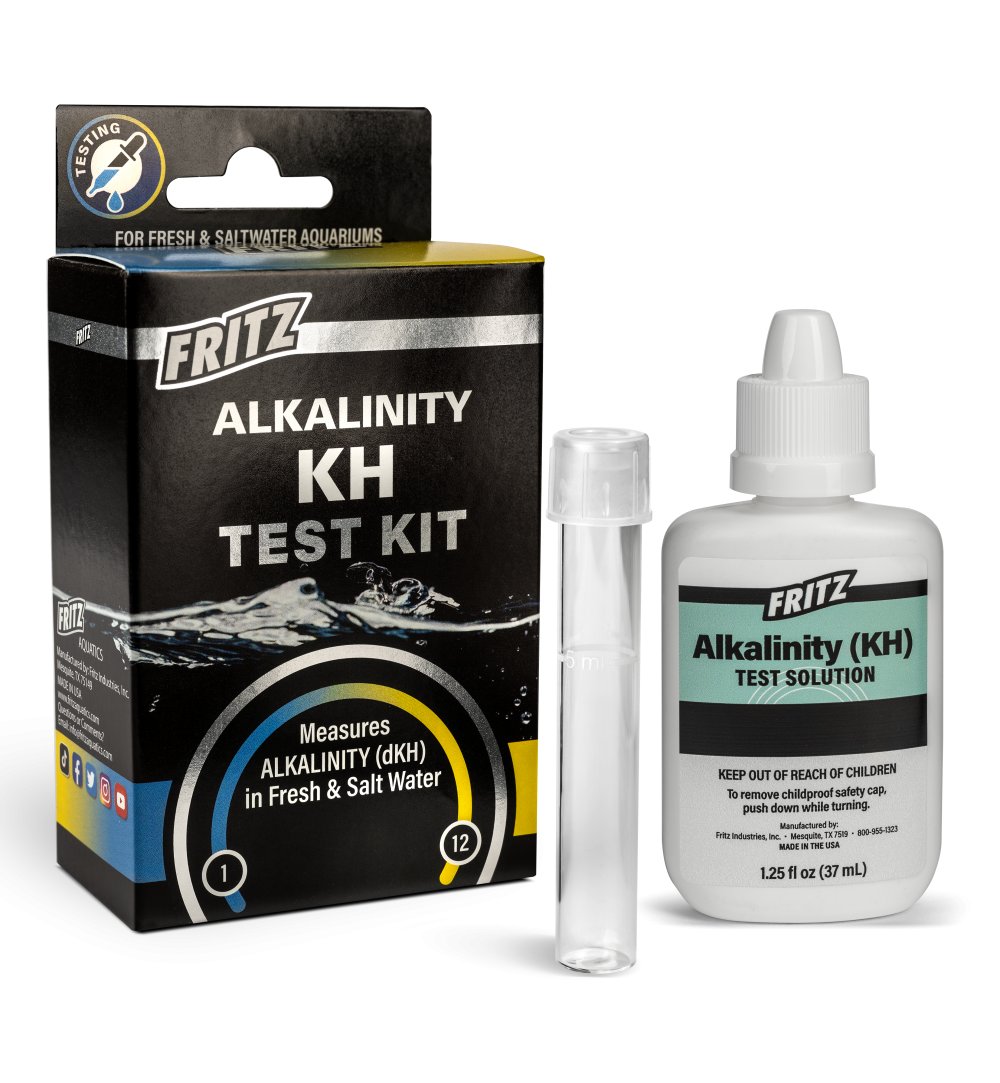
About Fritz Liquid Test Kits - Alkalinity
Carbonate hardness, or alkalinity (KH), is the measure of both carbonates and bicarbonates present in the water. The KH value of your water is important to know, as the carbonate hardness plays a significant role in the water�s pH and the water�s buffering capacity to keep that pH stable. KH naturally falls over time with the introduction of CO2 and other acids, and nitrification. Reverse osmosis water should be buffered with carbonates before use to raise and maintain KH. Some municipal tap water can have variable KH levels throughout the year and should be checked regularly. In saltwater tanks, KH can be tested to monitor the proper ionic balance when dosing.
Soft water fish, like Discus and other South American cichlids - 0 to 4 dKH (0 - 70 ppm)
Tropical community fish, like tetras and betta - 4-8 dKH (70 - 140 ppm)
African rift lake cichlids - 8 to 12 dKH (140 - 215 ppm)
Marine species - 8 to 12 dKH (140 - 215 ppm
Directions & Dosage
To remove childproof safety cap, push down while turning.
1 Fill a clean test tube with 5 ml of water to be tested�(to the line on the tube).
2 Holding KH Reagent Solution dropper bottle upside down in�a completely vertical position add one drop at a time. Cap the�test tube and gently shake between drops. Ensure you count�the drops as they are added.
3 The test is complete when the water in the test tube, after�having been gently shaken, turns from blue to yellow. If�you have difficulty discerning the color after the first drop�of test solution is added, remove the cap from the test tube�and while holding it over a white background, look down�through the tube.
The KH value is determined by the number of drops of�reagent that must be added to turn the water in the test�tube yellow. See conversion chart to determine KH.
Corrective actions:
To increase the KH of your water, add Fritz pH Higher. For a more significant KH increase for African cichlid systems, add Fritz Rift Lake Cichlid Buffer as needed. Fritz recommends a minimum of 4 dKH (80 ppm) for nitrification when using FritzZyme 7 or FritzZyme Turbo Start 700 bacteria.� This is also true for aquaLife Activate
To decrease the KH of your water, add Fritz pH Lower, or perform partial water changes with RO water. or us aquatic soil substrate such as soil aquaLife Andisol.
04006 tests qty variies
|
|